

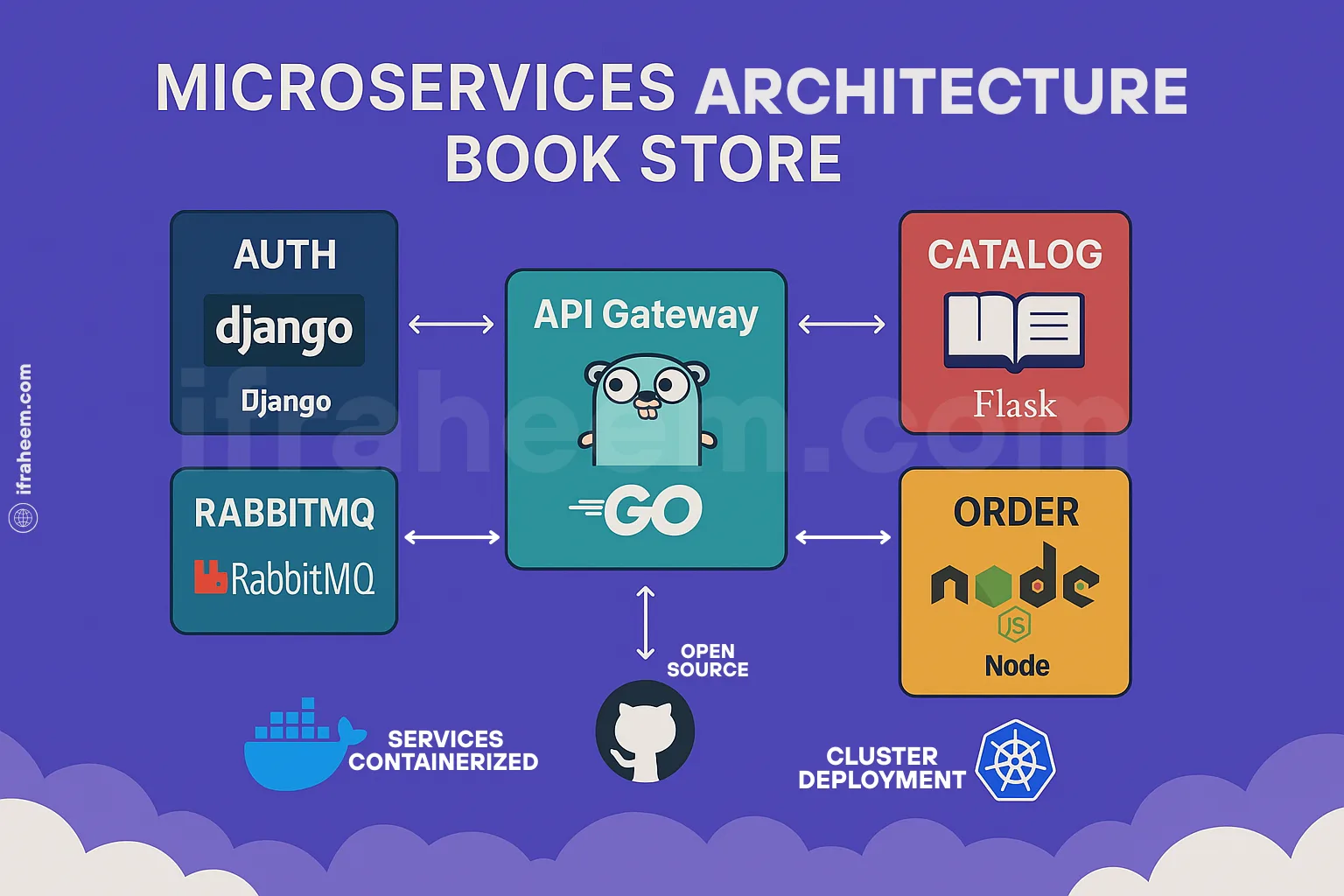
Short answer: A polyglot microservices architecture splits a backend into small, independently deployable services — each written in the language best suited to its job — that communicate asynchronously through a message broker like RabbitMQ. This walkthrough uses a real BookStore system: Django for authentication, Flask for the catalog, Node.js for orders, and a Go API gateway, all containerized with Docker and deployed on Kubernetes.
What is a polyglot microservices architecture?
In a microservices architecture, a backend is broken into small services that each own one business capability and can be built, deployed, and scaled independently. "Polyglot" means those services aren't locked to one language — you pick the right tool per service. The trade-off you're making is operational complexity in exchange for independent scaling, deployment, and team ownership.
The architecture at a glance
| Service | Stack | Responsibility |
|---|---|---|
| Auth | Django + DRF, JWT | Registration, login, access & refresh tokens |
| Catalog | Flask | Book records, inventory, stock updates |
| Orders | Node.js | Order creation and lifecycle |
| API Gateway | Go | Single entry point, routing, auth checks |
| Broker | RabbitMQ | Asynchronous events between services |
Why use different languages for different services?
Each service has different demands, and a polyglot approach lets you match the tool to the task:
- Django for auth — its batteries-included ORM, auth primitives, and admin make user management fast and secure.
- Flask for the catalog — a lightweight service with simple CRUD endpoints doesn't need a full framework.
- Node.js for orders — its non-blocking I/O suits the many concurrent, I/O-bound operations an order flow involves.
- Go for the gateway — compiled, low-latency, and excellent at handling high concurrency at the edge.
If you're weighing Python frameworks for one of these services, see my breakdown of FastAPI vs Django REST Framework.
How do the services communicate?
Services talk to each other asynchronously through RabbitMQ rather than calling one another directly over HTTP. When the Orders service confirms an order, it publishes an event; the Catalog service consumes that event and decrements stock on its own schedule.
This event-driven approach buys you three things: resilience (if Catalog is briefly down, messages wait in the queue instead of failing the order), loose coupling (services only need to agree on message contracts, not each other's APIs), and smoother load (spikes are absorbed by the queue instead of overwhelming a downstream service).
Why put a Go API gateway in front?
Clients shouldn't need to know about four separate services. The Go API gateway is the single public entry point: it routes each request to the correct service and centralizes cross-cutting concerns like validating JWTs issued by the Auth service. Go is a strong fit here because the gateway sits on the hot path for every request, where its low latency and concurrency handling matter most.
How is it containerized and deployed?
Every service ships as its own Docker image, which keeps environments reproducible and dependencies isolated. Those containers are deployed to Kubernetes, which handles scheduling, health checks, service discovery, and independent horizontal scaling — so you can scale the Orders service on a sale day without touching Auth. A CI/CD pipeline builds and rolls out each image independently.
When should you NOT use microservices?
Microservices are not a default — they add networking, deployment, observability, and data-consistency overhead. For a small app or an early-stage product, a well-structured monolith is usually faster to build and easier to run. Reach for microservices when you genuinely need to scale or deploy parts of the system independently, or when separate teams need to own services autonomously.
Conclusion
A polyglot microservices architecture is about deliberate trade-offs: you accept operational complexity to gain independent scaling, per-service technology choices, and resilient, loosely coupled communication via a broker like RabbitMQ. Containerizing with Docker and orchestrating with Kubernetes is what makes that complexity manageable in production.
You can see the full build on the BookStore Microservices project page.