

Short answer: To deploy a Dockerized backend on AWS, pick by how much control and operational work you want: Lightsail for the simplest fixed-price hosting, ECS (with Fargate) for managed, production-grade containers with no servers to patch, and EC2 when you need full control of the machine. Most teams should start with Lightsail or ECS Fargate and only drop to EC2 when they have a specific reason.
Which AWS service should you use to deploy Docker?
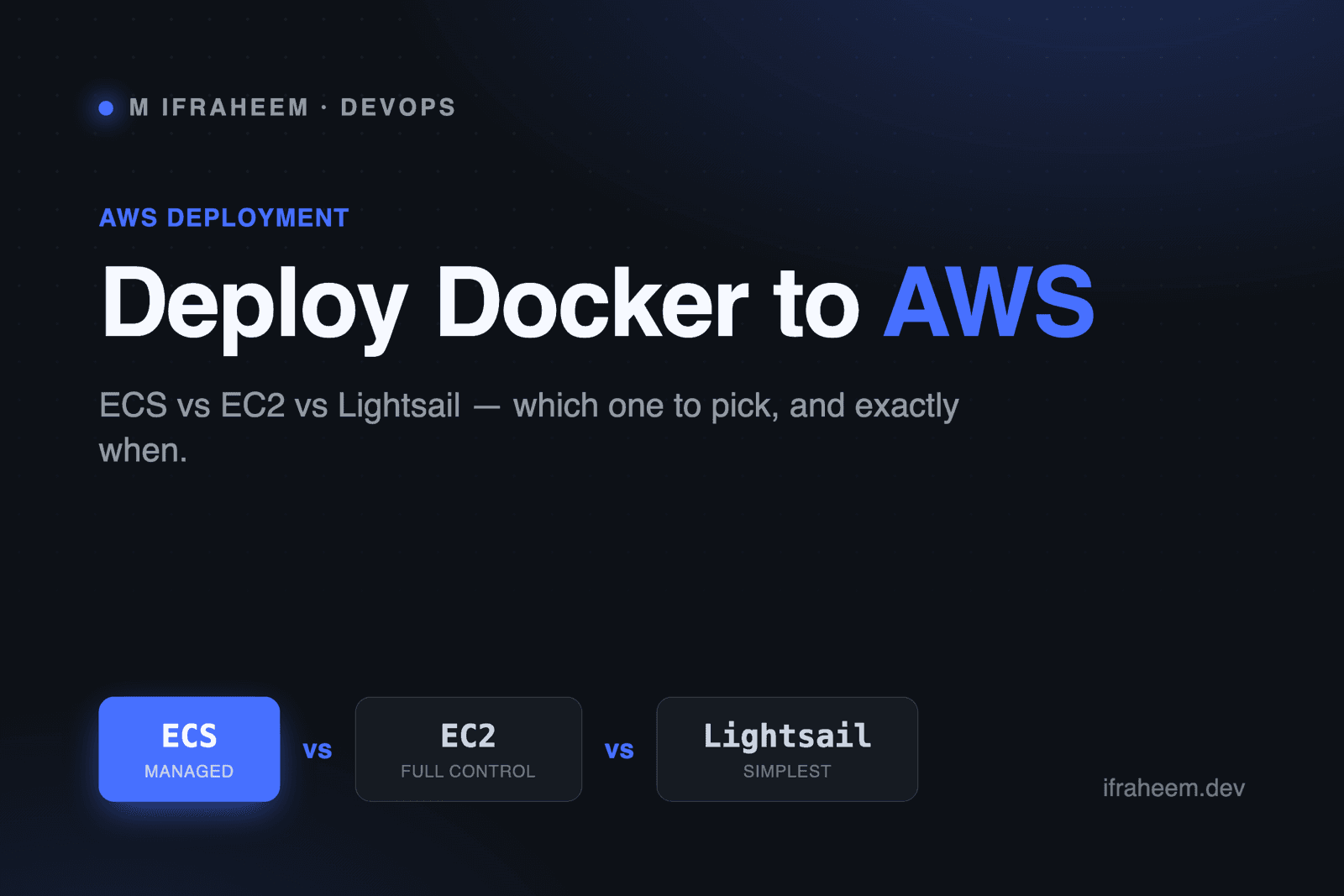
AWS gives you at least three sensible ways to run a container, and the "best" one depends entirely on your priorities — simplicity, management, or control. They form a ladder: Lightsail hides almost everything, ECS manages the hard parts for you, and EC2 hands you the raw machine. Below I break down when each one is the right call, then show the deploy steps.
At a glance: ECS vs EC2 vs Lightsail
| Service | Best for | Control | Ops effort | Rough cost |
|---|---|---|---|---|
| Lightsail | Small apps, side projects, MVPs | Low | Minimal | Flat, from ~$7/mo |
| ECS + Fargate | Production apps, hands-off scaling | Medium | Low | Pay per vCPU/memory used |
| EC2 | Full control, custom hosts, cost tuning | High | High | Cheapest raw compute, you manage it |
When should you use AWS Lightsail?
Reach for Lightsail when you want your container online with the least possible AWS ceremony. Its Container Service takes your image, runs it behind managed HTTPS, and bills a predictable flat monthly rate — no load balancers, IAM policies, or VPC setup to reason about. It's perfect for a small API, an MVP, or a client project that doesn't need to scale to the moon. The trade-off is a lower ceiling: fewer knobs and less integration with the wider AWS ecosystem.
When should you use Amazon ECS?
ECS is the sweet spot for most production backends. Paired with Fargate, it runs your containers serverlessly — you define how much CPU and memory a task needs, and AWS places, scales, and restarts it with no EC2 hosts to patch. You get health checks, autoscaling, load-balancer integration, and rolling deploys out of the box. This is what I reach for when a service needs to be reliable and mostly hands-off, and it's the natural home for the kind of polyglot microservices I've written about.
When should you use EC2?
Use a raw EC2 instance when you genuinely need control the managed options won't give you — a specific kernel, GPU access, unusual networking, or the cheapest possible compute for a steady workload you're willing to babysit. You install Docker yourself, run docker compose up, and own patching, scaling, and monitoring. It's the most flexible and often the cheapest per hour, but it puts all the operational weight on you. For most people that's a step backwards from ECS.
How do you actually deploy the container?
For both ECS and EC2, the shared first step is pushing your image to Amazon ECR. Authenticate Docker, then build, tag, and push:
# Log Docker in to your ECR registry
aws ecr get-login-password --region us-east-1 \
  | docker login --username AWS --password-stdin \
    123456789.dkr.ecr.us-east-1.amazonaws.com

# Build, tag and push the image
docker build -t my-backend .
docker tag my-backend:latest \
  123456789.dkr.ecr.us-east-1.amazonaws.com/my-backend:latest
docker push 123456789.dkr.ecr.us-east-1.amazonaws.com/my-backend:latest
From there, ECS pulls that image into a service, and EC2 pulls it in your docker compose file. Lightsail skips ECR entirely — it has its own image push:
aws lightsail push-container-image \
  --service-name my-backend --label app --image my-backend:latest

aws lightsail create-container-service-deployment \
  --service-name my-backend \
  --containers '{ "app": { "image": ":my-backend.app.latest", "ports": { "8080": "HTTP" } } }' \
  --public-endpoint '{ "containerName": "app", "containerPort": 8080 }'
How much does each option cost?
Cost tracks the control ladder. Lightsail is the most predictable — a flat fee (around $7–$40/month depending on size), which is great for budgeting a client project. Fargate bills per vCPU-second and per GB-second, so a small, steady service is inexpensive but a busy one adds up; you pay for convenience. EC2 gives the lowest raw compute price — especially with reserved or spot instances — but the real cost is your time managing it. Cheapest on the invoice isn't always cheapest overall.
How do you make deploys automatic?
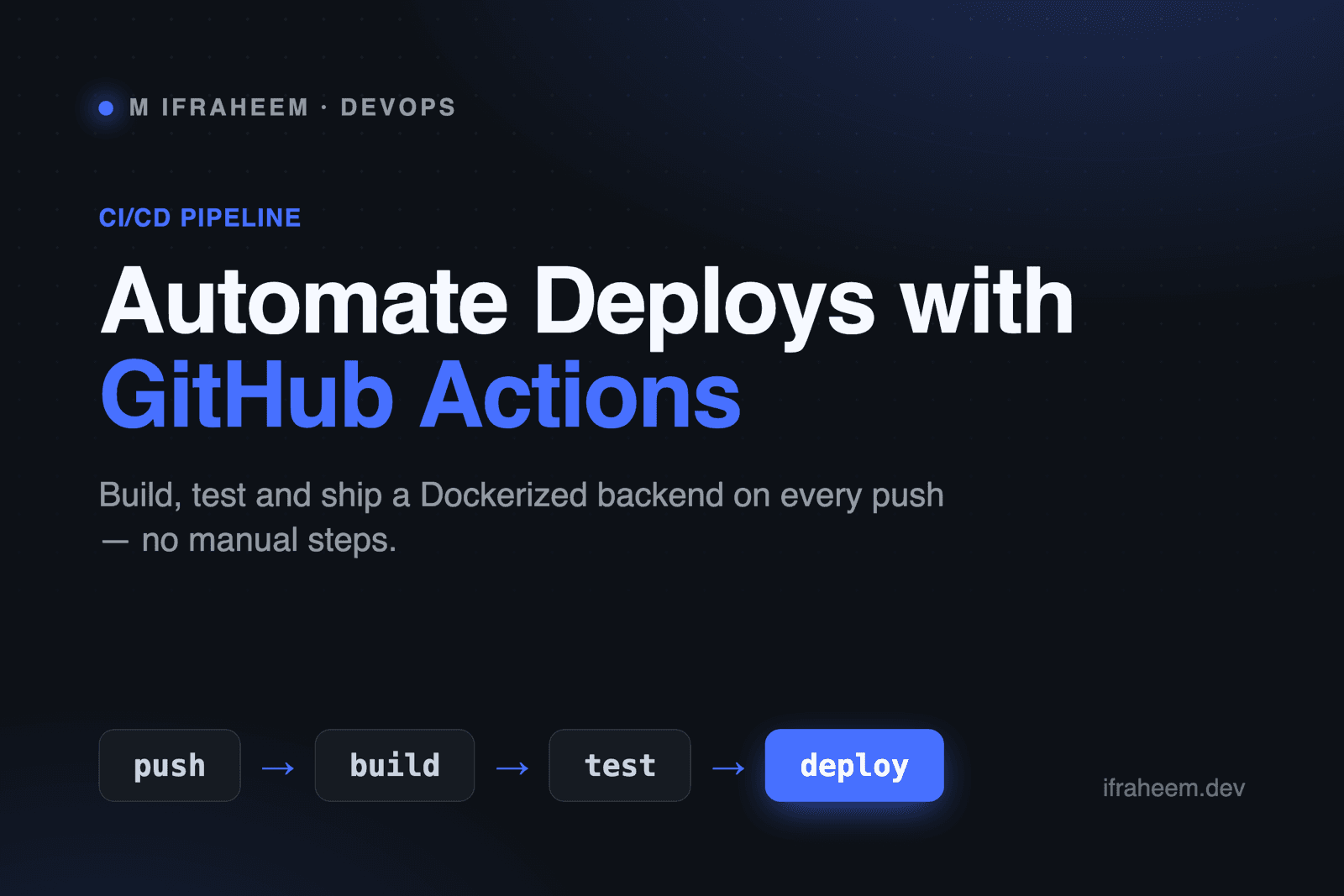
Whichever service you land on, you don't want to run these commands by hand. Wire them into a pipeline so a git push builds the image, pushes it, and updates the service. I covered exactly how to set that up in CI/CD for a Dockerized backend with GitHub Actions — the deploy job just swaps in the ECR push plus an ECS or Lightsail update step.
Which should you choose?
If you want a simple recommendation: start with Lightsail for small or early-stage apps, move to ECS Fargate when you need real production reliability and scaling, and only use EC2 when you have a concrete requirement that forces it. Choosing the simplest option that meets your needs — not the most powerful — is almost always the right DevOps instinct.
Conclusion
Deploying Docker to AWS isn't about finding the one "correct" service — it's about matching the tool to how much you want to manage. Lightsail trades control for simplicity, ECS trades a little control for managed reliability, and EC2 gives you everything at the cost of doing everything. Pick the lowest rung of the ladder that solves your problem, automate the deploy, and you'll ship confidently without drowning in cloud configuration.
Need this set up for your own project? See the DevOps and cloud services I offer, or hire me to build the pipeline end to end.